
Where did these letterforms come from? Who made them, and why?
At least five title fonts have been used for the US editions of this fantasy series by Brandon Sanderson. Of those fonts, the most iconic and longest-reigning is unquestionably the one pictured above. I wanted to learn its story if possible.
And what a story has unfurled. Let me tell you in the plainest words I can devise. A traveler describes a land of mist where planets incarnate raise mortals to gods. The traveler’s book is emblazoned with a curious alphabet, originally inscribed in a pillar of sand by a certain calligrapher, in imitation of a lion who preached a mythic land where incarnate planets raise mortals to gods.
See Part One and Part Two for further context. This is Part Three, where I explain everything. Finally.
______
Contents
Origins • Rune cutter of the Renaissance • The climax of mainstream magic • The primal empire • Planets incarnate • Conclusion
______
Our English word “rune” descends from rūnō of Ancient Nordic through rún of Old Norse, Old English, and Old Irish (Koch). The primary meaning of these original words is “secret [knowledge].” In a variety of Germanic and Celtic languages, this root diversified to mean “plot,” “mystery,” “whisper,” “council,” “arcana,” and “enchantment.”
Hávamál, an important source from the Viking Age, tells cryptically that Odin claimed the runes somehow—took them up screaming—while hanging in sacrifice from a windy tree which “rose from roots / that no man ever knows.” The runes are cut/carved/written in different translations. More recent scholarship has found no definitive origin for runes, but some link to Greek or Latin is likely, transmitted and transformed perhaps a millenium before the Viking Age (Miller).
Runes are thus Germanic cousins to the Latin alphabet you’re reading now. Until the spread of Christianity with Latin script in tandem, runes dominated writing in Scandinavia. Nordic peoples of the Iron Age did consider runes powerful and sometimes employed them for magical effects, although the mystique of runes may have become exaggerated as they later fell out of common use.
Literacy during the Viking Age is not fully understood. Nor are all inscriptions securely deciphered. Yet most runic texts are formulaic and unsensational. They often establish ownership and land rights, family ties, inheritance, and legal codes. Some wax poetic or offer tantalizing hints of worship (Brink ch.21).
Sweden hosts the great majority of runic inscriptions left over from the Viking Age. These have influenced Sweden’s visual culture and self-image for centuries. But few of us know, or even think to ask, how runes have been used in Scandinavia for the past thousand years.
For me it certainly remained a mystery how the broad curves of Palekin might reflect runes, which I pictured as tall, thin monolines with hard angles etched in stone, until my research chanced across the scanned pages of Rvna ABC Boken, 1611, written and designed by one of Bo Berndal’s oft-cited sources of inspiration.
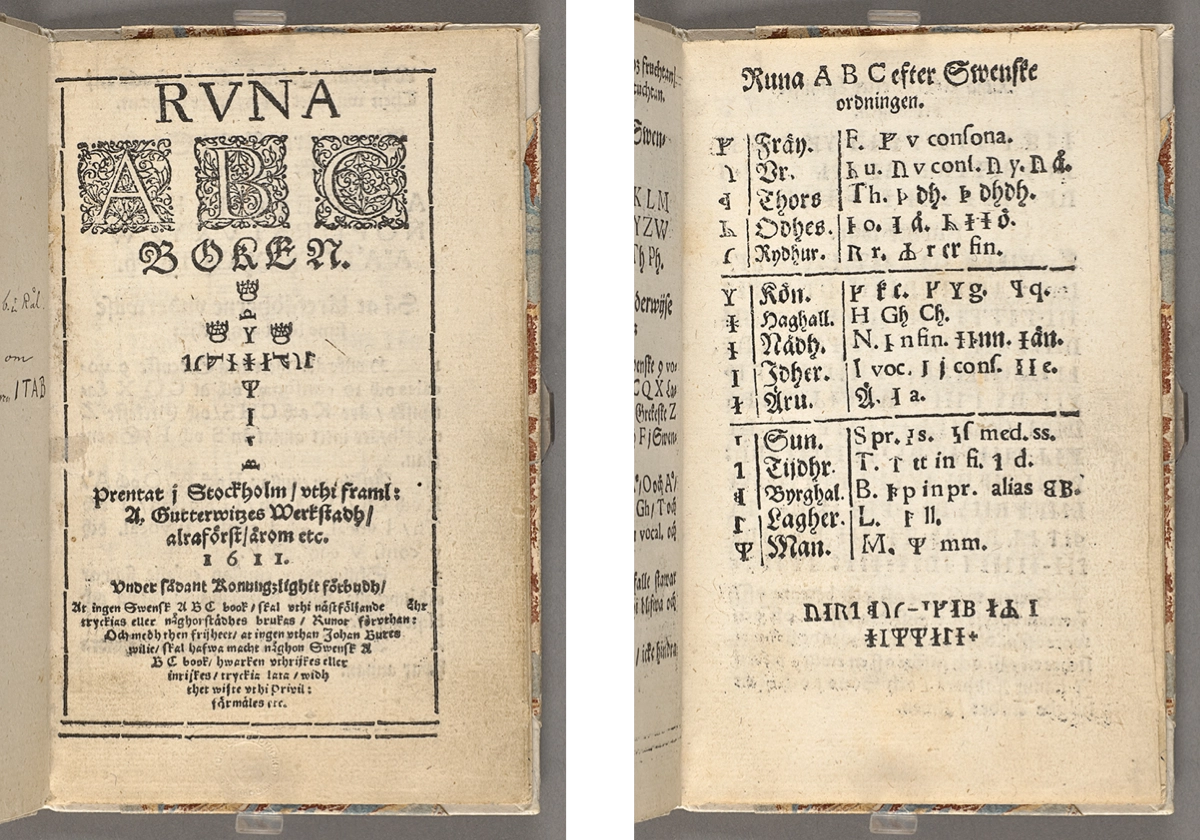
These runes offer a resemblance like I hoped to find! These runes are domesticated to 1611 standards, adapted from their primitive forms to match the surrounding text. Given serifs and similar stroke thickness, the runic script sits comfortably beside the day’s typography. Serifs made the runes more readable, says Bo (Frigyes Typiskt 177). He applauds the designer’s innovative choice to model this runic type after the roman style rather than blackletter, which was more conventional at the time. The roman of course entails more lightness, that favorite quality of Bo’s.
The key similarity is in the round shapes. Palekin’s most distinctive characters, Y or K or N, belong here like nowhere else. Proportions and stroke widths are much alike. Given those commonalities, the visual rhythm of text set in Palekin also resembles these runic lines. Also take note of the way space inside the runes is often ajar, almost-not-quite closed off, like the font. This appears to be true for all the “candelabra”-style runes, even if some serifs have fused where the ink bled out in printing. I include the runic R (*raidō) in the diagram below to show another case of this particular cracked-open feature.
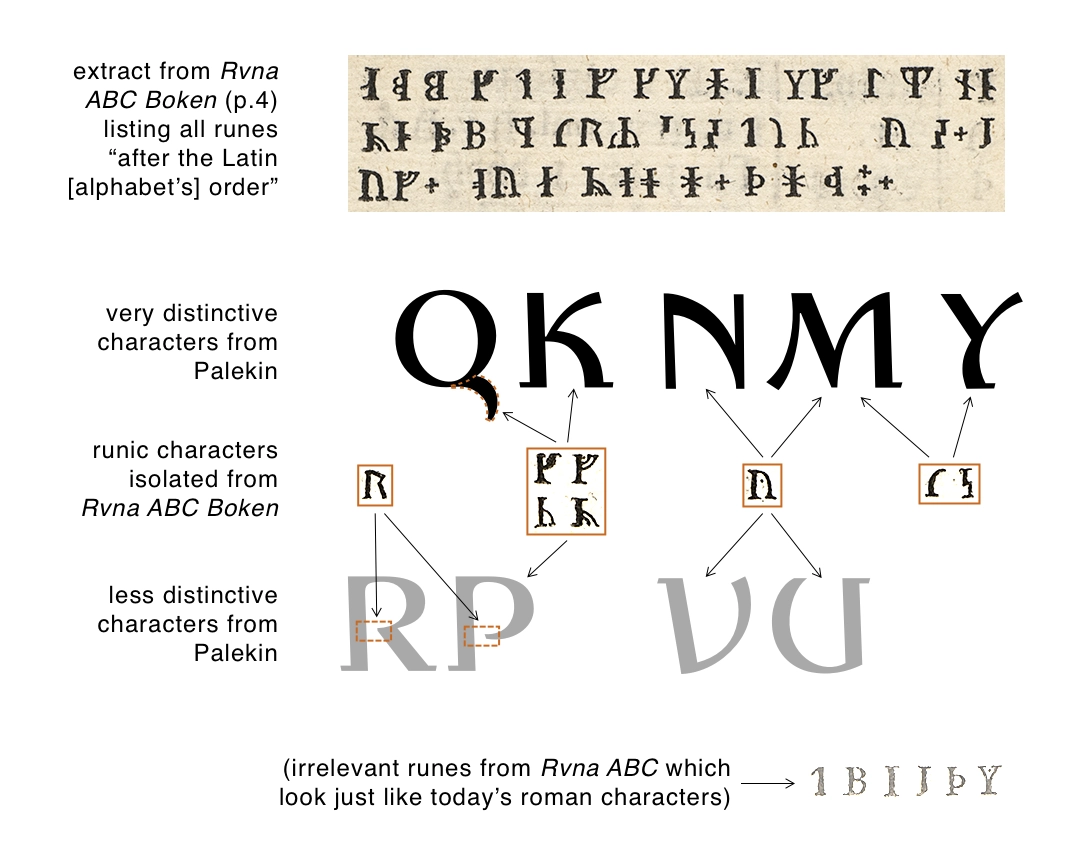
Note: You may glimpse seeming letters like I, J, P, B, Y, and the number 1 among the runes. Don’t mind these. They match standard Latin-alphabet forms too closely (even if phonetics don’t always correspond, e.g., the thorn Þ is not a P) to be meaningful points of comparison.
These typographic runes do not exhibit the leftward slant and semi-serifs of Bo’s font. Since Bo would establish a habit of shearing off serifs (already in Exlibris; later with Fripress/Presstek, Golota, Mixtra), I’d consider it Bo’s personal mark on the design, and a way of modernizing it.
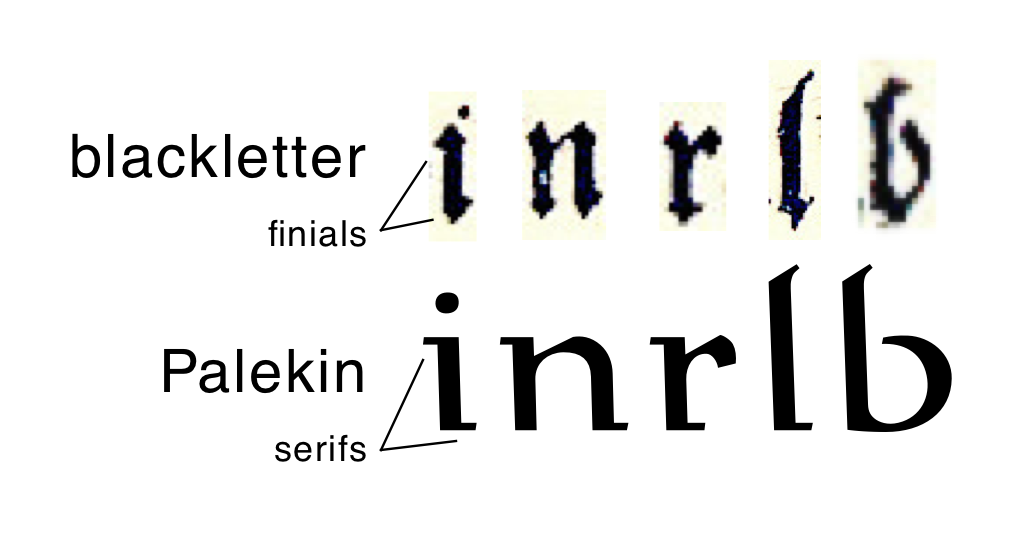
Yet I see another explanation. Here, just maybe, the blackletter on these pages had some influence on Bo’s design. Compare the lowercase i/n/r/l/b, for example, between the modern font and the old blackletter type. One thing they have in common is the placement of finials, which are triangular or diamond-shaped flares on the blackletter, transmuted into serifs for Palekin.
The blackletter connection could be overspecific. The culprit may be calligraphy in general. As the pen flows across the page, in many historical forms of calligraphy, the letters often begin and end in flourishes, which give closure to the longer strokes. It would be natural for Bo to rely on calligraphic rules to dictate where serifs fall in Exlibris, Palekin, and the like.
Palekin is no replica of this runic typeface; it’s not trying to be. But the inspiration is evident in the characters that most set Palekin apart.
Rune cutter of the Renaissance
Johannes Bureus, or Johan Bure as he is known in Swedish,* lived between 1568 and 1652. Bureus tutored Gustaf II Adolf, under whose reign Sweden climbed toward the height of its golden age. The king’s support allowed Bureus to pursue studies of history, genealogy, runology, and alchemy.
The Uppsala area, where Bureus grew up, hosted a heavy concentration of runestones. He studied runes for their historical value yet also promoted their mystic powers. From his high position, at a formative juncture in the making of modern Sweden, Bure also worked for the revival of runes. Hence the ABC book, a primer made for teaching the runic and latin alphabets together. It came with a decree from the king making the subject obligatory for students (Håkansson 337).
* You’ll see I sometimes prefer Bure [two syllables, much like “boo-ray”] because it’s easier to work with, and it was his native name, and I’ve read that form of it repeatedly in the book which is my main source on him. I am sorry about the mental load of all the B names—Brandon, Bure/Bureus, Bo Berndal.
It was a period of great social upheavals in the world: the Reformation and subsequent wars racked Europe. A rift began to split science and theology; the Church battled Galileo. Global empires began to establish lasting roots. Economies surged and crashed with resources flowing in from Asia and the Americas.
Much of this may seem distant to Sweden, yet was deeply significant there. Sweden was a major contender in the Thirty Years’ War. Devastating in central Europe, where it was fought, the war brought power and wealth to the ascendant Swedish Empire.* Gustaf II Adolf became known as the Lion of the North for his defense of (or at least, aggression nominally on behalf of) Protestantism in this conflict. He died on the battlefield.
But no, Gustav II Adolf is not the lion I have in mind. The one to follow here is Bureus, the (self-styled) lion prophet of the north. Pardon the confusion. Everyone wants to be a lion.
* Known in Sweden today as stormaktstiden, “the era of great power,” referring to the imperial period of 1611–1721, although the term also gets used in a general sense for any nation’s apex political/cultural/military power
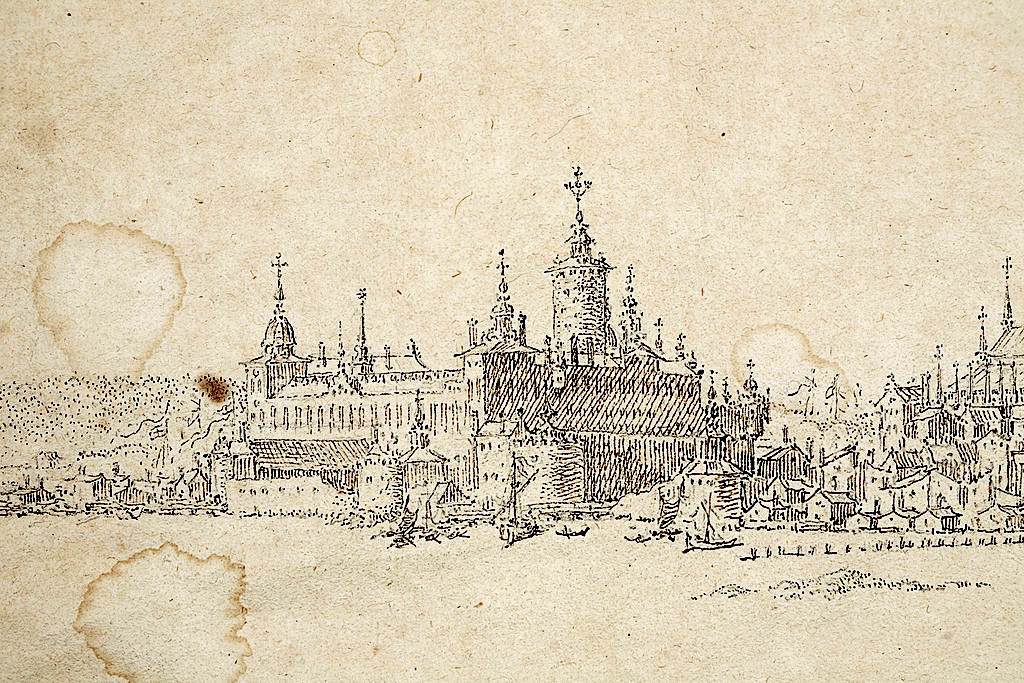
Stockholm grew into a metropolis. The nation rose from its fragmented, backwater status to unite as a real power in Northern Europe. During and especially toward the end of Bure’s life, the monarchs sought to build its cultural cachet on a foundation of learnedness and antiquity. Treasures, books, runestones, and (especially) the interpretations thereof were essential assets for the kingdom’s grandeur. It’s been a very common pattern for nations of Europe to jostle for mythical lineage, whether by blood or philosophy, from the Bible, the Hellenistic world, and the Roman empire. This continued right up until the 20th-century world wars. The aftermath of, for example, Nazism and colonialism may have made it sort of unpopular to openly emulate the Romans.
Like many golden ages—take for example Spain’s parallel Siglo de Oro, glutted on spoils from the Americas and producing some of its most riveting works of art and literature—the golden veneer is brittle. At the time Bureus died in 1652, after decades of war, despite its splendor “Sweden was a destitute and depopulated colossus: a kingdom of invalids, widows and orphans” (Håkansson 8).
Bureus himself grew up in conditions of poverty. By the 1590s, in his 20s, he had nevertheless become an expert in runes (Håkansson 235). The next decade saw him admitted to the royal court. He was appointed royal librarian, Sweden’s first royal antiquarian, and tutor to the crown prince. The vast library exposed him to the source texts of arcane metaphysics that would enthrall him thenceforth. In Bure’s middle age, another decade later, 1613, God began to speak to him.
At times he heard a voice with his waking ears. Messages also came via symbols, life events, or dreams. In grand strokes they told him, The end is nigh—obey God—don’t be seduced by false worship—that is, don’t be Catholic!—but you know those pagan ancestors? not pagans. just honest God-fearing people, victims of slander. they had it all figured out, so let’s bring back the magic).
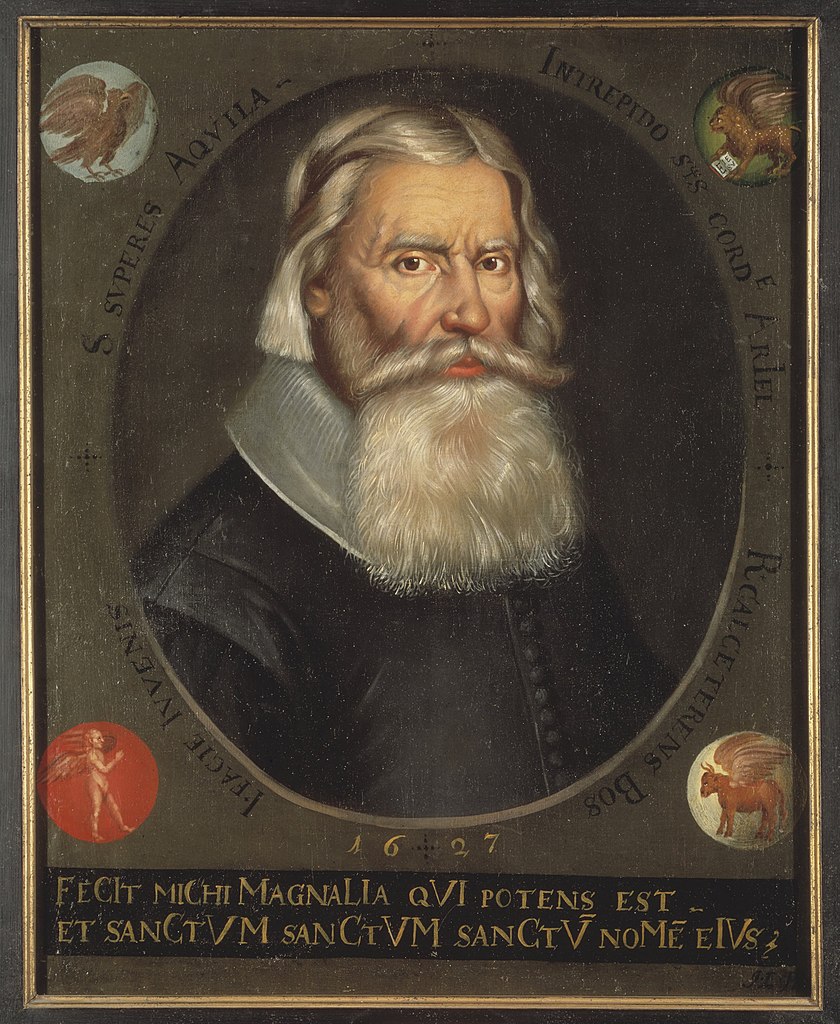
Bureus would now claim more grandiose titles for himself: prophet of God, foretold biblically as the Lion of the North, angel who breaks the seventh seal to announce the destruction of the world. Yeah. His iconic 1627 portrait makes use of commonplace symbols—eagle, man, ox, lion—with unique interpretation. These are four heralds of the apocalypse: first Jesus, then a proto-Reformer and martyr named Jan Hus, later Martin Luther, and finally, none other than Bureus himself (Håkansson 11).
We can form an impression of Bure’s character from his own writings as well as the reputation or firsthand encounters recorded by others. From that impoverished background, he felt immense honor in his elevation to court yet struggled to adapt his austere lifestyle to the extravagance there (Håkansson 279). “Not even four centuries can hide the fact that Bure was a fairly wooden character, withdrawn, humorless, and often maddeningly self-important” (20). Many peers found him eccentric (13). He was of course bookish, and a bit obsessive (26, 281). Once convinced of something, Bureus would devote all his energy to it, and where unconvinced, he’d leave countless notes in the margins of your book: you lied Goropius; great lie; you’re wrong; wrong; wrong (18).
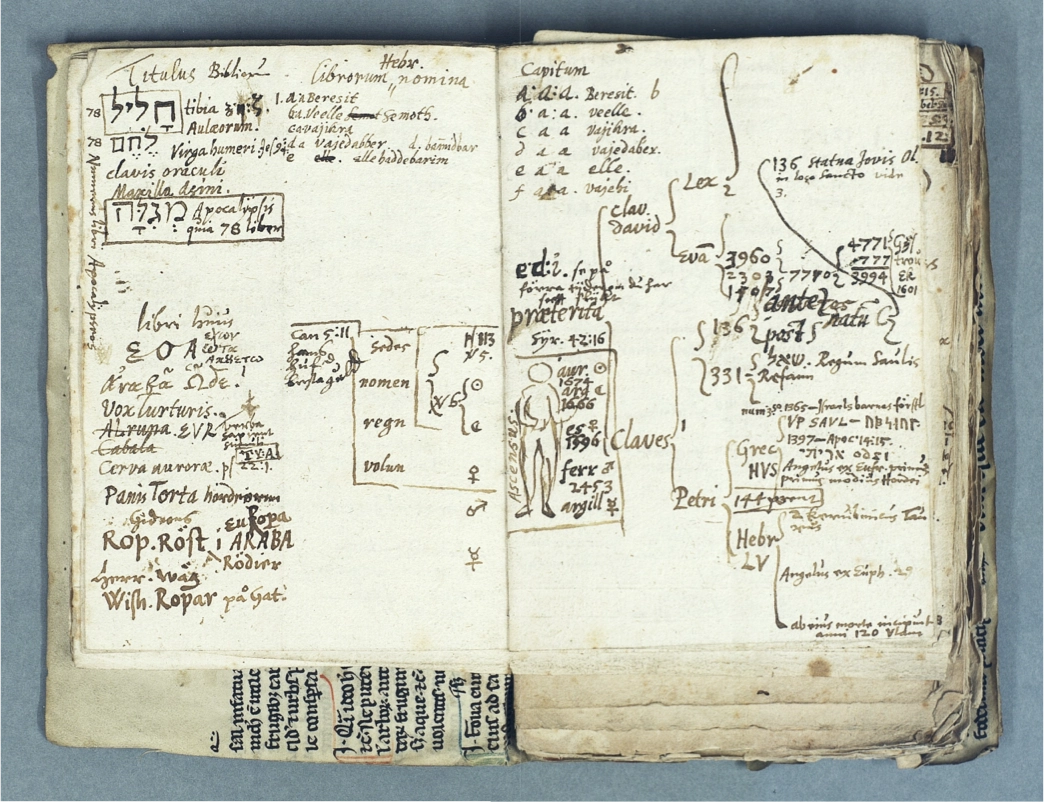
He read secret meaning into everything possible. We know because he made painstaking annotations of steps walked, dates and times, all his family’s minor mishaps (Håkansson 281). Tooth- and bellyaches. Portentous dreams. A cross-shaped scar. His own horoscope which, according to his calculations, matched that of Jesus. His biblical name—never mind that he shared it with millions of other Johns, Johans, Jans, Evans, Ivans, Ians, Jeans, and Janes born since the start of Christianity.
The climax of mainstream magic
As my source Vid Tidens Ände stresses repeatedly, Bureus was immersed in a time and culture where magic, religion, and science were thoroughly entangled. Isaac Newton, for example, wrote volumes of essays on alchemy (Håkansson 345). So Bureus wasn’t just a crackpot. The era’s scientific revolutions, in close company with alchemists’ creeds, were driven by quests to understand and reverence God through natural law (262).
According to the Christianized Platonic worldview, favored by Renaissance thinkers, all aspects of creation belonged to a single, “all-knowing living vessel” (Håkansson 287) whose deepest truth was immaterial, expressed imperfectly in the material world. Sciences like alchemy sought access to the underlying reality through occult formulas. It can be hard for us moderns to appreciate how the “highly developed art of alchemy was an adjunct to religion, not its substitute or adversary” (Heninger 235). Magic led to the Creator. Magic was an essential strand of the realest reality. Most academic circles in Europe accepted this in principle, even if the boundaries of white magic, and the human license to wield this power of God, stirred up endless controversy.
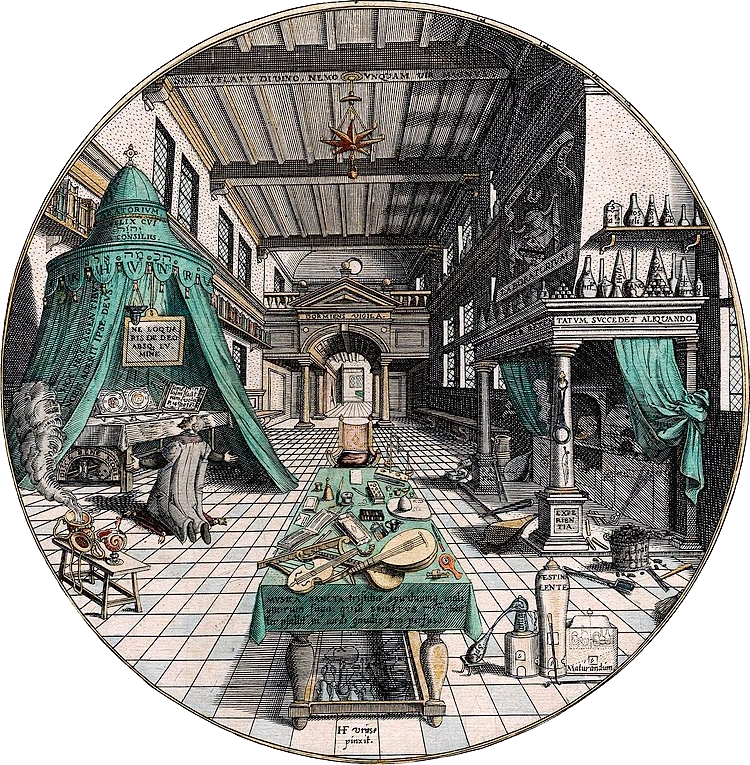
Renaissance magic derived naturally from this highly rational and endlessly complex system, which had for centuries been twining together strands of Jewish and Christian theology, classical philosophy, astronomy, geometry, mysticism, and other cultural threads from across the Mediterranean and Near Eastern worlds. While much of it appears irrational to us, renaissance knowledge was structured meticulously in a framework of basic premises, such as God created an organized, symmetrical, and comprehensible universe. There were equations: Symmetry = Beauty = Goodness = Truth = God. There were universal constants, like four—evangelists, elements, seasons, bodily humors, winds, cardinal directions.
Of course there were crackpots. But if the whole enterprise had been a mere carnival of delusion, we wouldn’t have our pioneers of the modern sciences like Newton or Copernicus—both of whom, like many of their peers, worked in service of orthodoxy, not in rebellion against it.
The Cosmere seems to be building towards the same image of coherence and harmony as the sort of cosmos favored by renaissance scholarship. Every action is matched by reaction, as Kelsier tells Vin in her first Allomantic lesson: “When you push against something—whether with Allomancy or with your hands—it goes directly in the opposite direction. Force, reactions, consequences.” (Sanderson Mistborn 145). Take this to its extreme, with every part of the universe intrinsically responsive to every other, all things twinned by Push/Pull logic, and you have a system like alchemy. All actions send cascading effects across the switchboards of reality. It becomes reasonable that an actor may, with proper understanding, operate the levers that move planets and determine the essence of metals.
So it was not unusual for Bureus to claim magnets operated by the same divine magic that staunched bleeding through a necklace of dried toads (Håkansson 283). Nor that he returned from a trip to the countryside with a bundle of troll bones (25). Where he did innovate was in claiming prophethood and, more significant to the story of Palekin, in formulating the concept of adelrunor (adulrunae), “high” or “noble” runes.
Common runes were mere letters. Their secret counterparts, the adelrunor—so secret Bureus was the only one talking about them—were no less than the alphabet by which God made the world, and by which humans could attain godlike status. Adam wrote with runes in the beginning (Håkansson 19). This adelrunor concept was inspired by alchemical perspectives on Kabbalah and Egyptian hieroglyphs. Bureus derived the term from his original interpretation of Classical writers describing strange peoples of the north. Tacitus, Jordanes, and later commentators spoke of “aurinia” or “adelrunae,” wise women with supernatural power. Yet no, thought Bureus, it wasn’t about the magic user but the magical symbols. That is indeed the meaning of adel “noble” + runa “rune” (the plural is runae in Latin, runor in Swedish), much like hiero + glyph is literally “holy engraving.”
If you have Sanderson in the back of your mind, these would be more like the Aons of Elantris than anything in Mistborn.
When the key text of Kabbalah, Sefer Yesira, describes God fashioning the world from the 22 Hebrew letters, these are more like physical objects than marks on a surface. More like metal type than strokes of ink. God cuts out, weighs, and combines the letters to shape all life (Håkansson 349). Christian alchemists like Bureus seized on Jewish esoterica and claimed superior understanding. Bure’s personified Adelruna proclaims in verse, “The Jews call me Kabbalah, / Known of yore in Uppsala…” (Håkansson 351). This kind of flagrant claim to origins represents a typical pattern in Bure’s work.
The primal empire
For Bureus, runes didn’t point to the Vikings so much as the all-important Goths. One reason his royal patrons kept him around, despite their own misgivings and controversy at court, must have been the support Bureus lent to Gothicism. One half of this theory was that the ancient Goths, who we may remember for sacking Rome, had their origin in Sweden.* Götaland, land of Beowulf ’s Geats, is highly suggestive here.** The other half of the theory was that all European civilization had its origin in the Goths (and therefore Sweden). Such claims were at this time common justifications for the royal house’s power and violence (Håkansson 16, 236). Kingdoms across Europe were making the same sorts of claims for their special heritage.
Former Swedish literati like Johannes and Olaus Magnus*** had already established the tradition of powerful magic-wielding Goths with an alphabet preceding the Greek and Roman ones. The Magnus brothers brought runes (with serifs!) to print almost a century before Bureus, but these were not actually cut as moveable type. They were engraved in illustrations.
* This belief would later fall from favor. A different version was revived in the 19th century, with new emphasis on the Vikings. Scholars today dispute the origin and identity of the Goths. They were almost certainly located in the Baltic vicinity, but not necessarily in the modern territory of Sweden.
** So are the Gutes, Jutes, Gotland, and Jutland.
*** Bo Berndal honored them with a couple of fonts in 1992, shortly before Palekin.
Antiquity was crucial. Antiquity was authority. Whether to build a convincing national heritage, or to revive lost magic, intellectuals across Europe turned to the same bedrock layers. These were biblical Genesis, Egypt, classical Greece, and Rome.
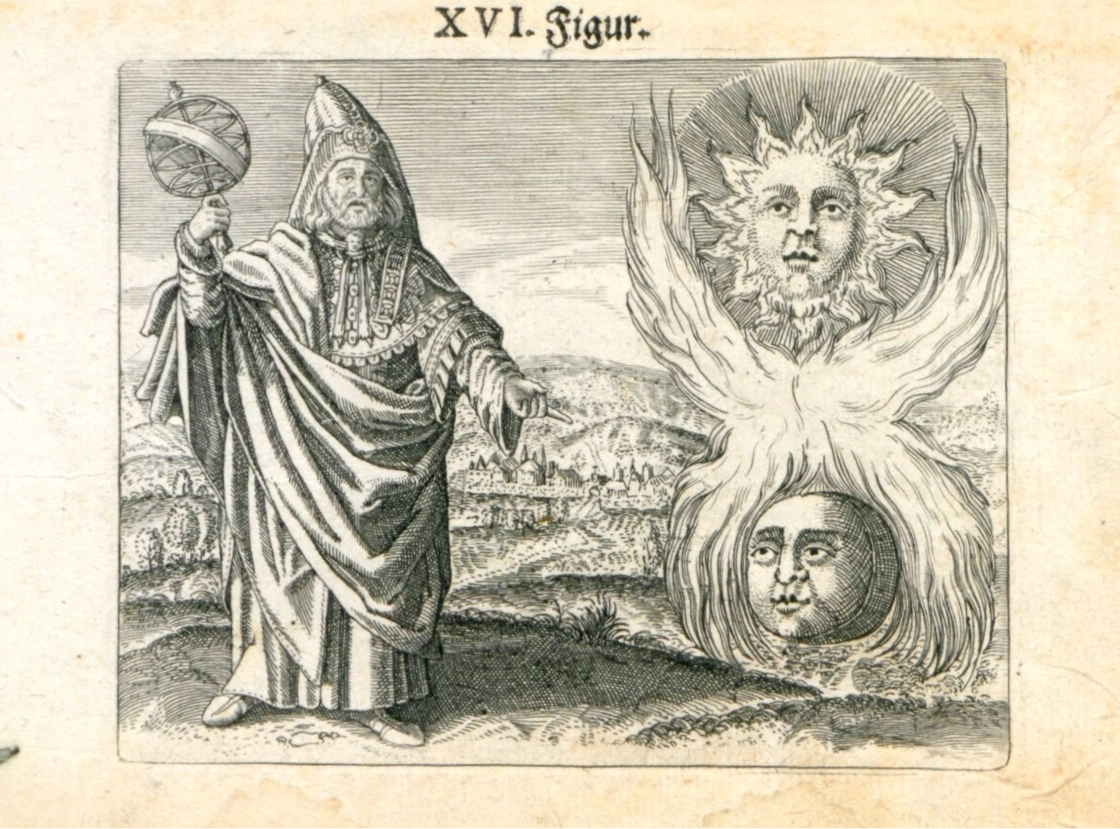
As seen from the Renaissance, the archetypal Greek philosopher “wente into Egypt and Babylonia, to lerne misticall sciences” (Heninger 25), becoming an “exhaustive syncretizer of earlier cultures” (28). Such a philosopher was at the root of civilization, and the end goal of alchemists. In order to craft a unified corpus of knowledge, they needed contributions from multiple sources. It’s a classic irony how often they tried to make that exotic variety domestic. It seems at the time, academic integrity demanded a commitment to patriotism.
Thus, Bureus was never content to emulate what he admired in other cultures. It had to be Swedish—or be made Swedish. He retconned history with headlong enthusiasm. Most great advancements of the past could be attributed to the Goths, if you assembled the evidence with a certain determination.
Bureus shifted the emphasis from the Goths’ prowess in conquest to their heights of learning. Through various devices, with relentless fervor, Bureus contrived to bestow all knowledge and invention on the Goths. He awarded them credit for the great achievements of antiquity, and the symbols most valued in alchemy: the compass, pyramids, obelisks engraved with sacred and secret knowledge, the philosopher’s stone, runes and indeed writing as a concept. Through his travel, study, and careful cataloguing, Bureus dressed up Gothic pretensions in a regalia of scholarship. He believed their great unified knowledge had split* into Kabbalah, alchemy, magic, and astrology (Håkansson 342).
* One source, several magic systems. Hm. I’m sure I’ve run across this idea somewhere…
Creative etymology was one of his favorite tools in this endeavor. Famous names from ancient Greece were obviously Gothic, and therefore Swedish. Hermes/Mercury was Märkur (meaning “sign” or “mark,” Håkansson 327), Apollo was Äbolle (a god worshipped anciently at Uppsala, p.333), and Hercules was Härkulle (meaning “head of army,” king or warlord, p.332). Even Zoroaster must be a corruption of Thorfaster, meaning “bound to Thor/God” (p.329). The pagan trinity Odin, Thor, and Freya could be neatly equated with the Christian Trinity.
In short, the apocalypse that actually called Bureus as prophet was the spectacular rise of nationalism. This was a force gathering peoples of the earth, the energies of warrior and scholar alike, to make the ultimate expressions of empire.
Bure’s runic type is an appropriate symbol of the enterprise. Language, written or spoken, is foundational to identity and community. Print made possible the unprecedented norm of literacy as well as a new consolidation of spoken vernaculars. Luther’s vernacular rendition of the Bible, for example, is often credited with forging a panoply of regional dialects into one standard German. A shrinking number of print languages therefore had wider ranges of contact than speech had formerly. These print languages coalesced into new sources of power, forming a critical battleground for revolutionaries and governments.
By proliferating the written word with its stability and longevity, print also enabled a “new fixity of language” which promoted “that image of antiquity so central to the subjective idea of the nation” (Anderson 44). Like Sweden with its Gothic pride, nations have historically legitimized themselves by claiming illustrious, mythical, and ancient roots. It makes people believe a thousand years of imperial peace and prosperity are not only a possibility but a reality.
Bure’s efforts to bring runes into print are an expression of nation-making. They signaled the resplendent heritage and presented a vision for the glorious future of this emergent northern nation. This legacy is echoed in Palekin, which unexpectedly (or not?) fits the political dynamics of Mistborn. It’s a contest between ruin and preservation, change and stability, freedom and control. The Lord Ruler may wield godlike power, but like common tyrants, he rules by means of propaganda and systems of information management.
Planets incarnate
Why open this series of articles with a riddle? I’m mimicking one of the truly fascinating quirks of alchemical texts. To conceal powerful information from the unworthy, alchemists wrote their recipes in allegory. Elements were coded as angels, dragons, kings, salamanders, lions, beggars, or harlots. These characters interacted in ways that suggest steps like distillation, sublimation, liquefaction, making alloys, chemical transformations (Håkansson 345).
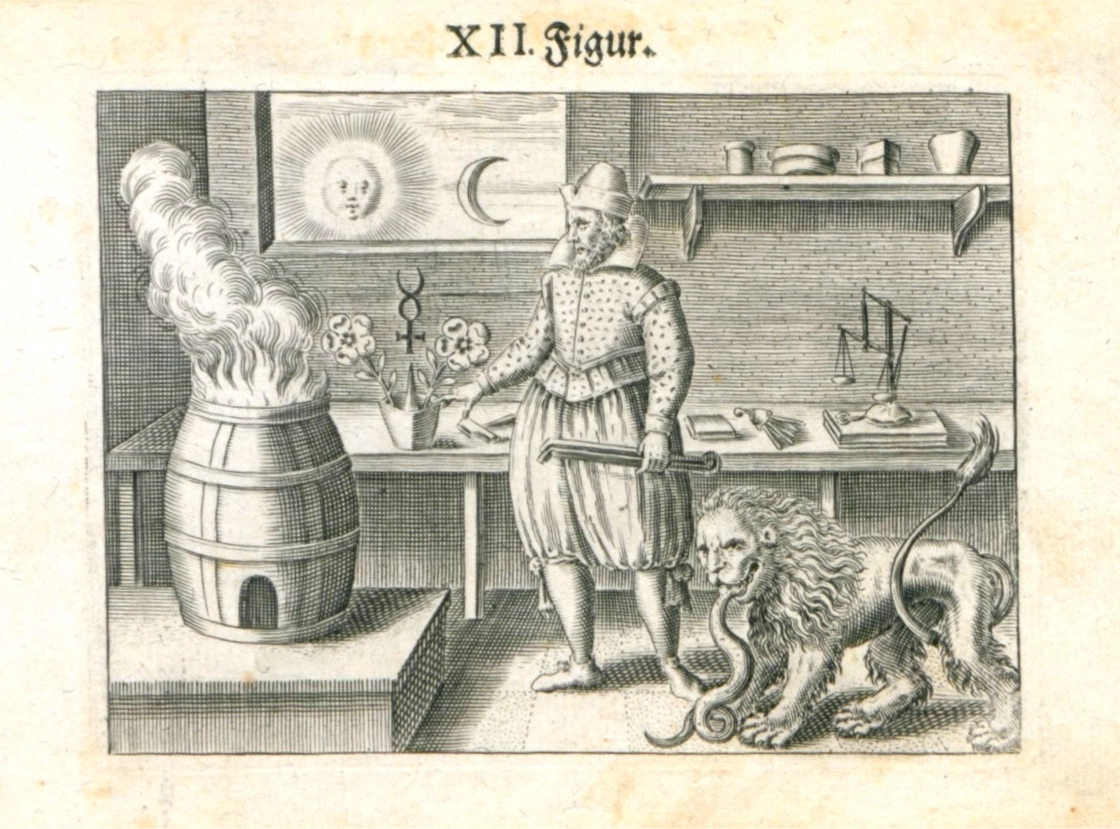
The magic systems of Mistborn also have interesting parallels to arcane powers which, for Bureus, were crowned by the adelrunor.
He read all the magical texts he could lay hands on. A favorite topic was making talismans by, for example, inscribing metal with symbols of power. There were multiple guides to this practice. One was Paracelsus, one of the authors Bureus adored (Håkansson 295–297); another was Liber runarum (Latin: Book of Runes). Liber runarum explains that each planet exercises its influence through an angel or spirit, and each planet with its angel is associated with a metal, and by inscribing runes on these metals it’s possible to call forth particular desired effects. Jupiter offers wealth and justice; Mars enables victory in battle or other contexts; Venus affects pleasure.
Certain metals, worn as jewelry, produce certain effects. Not far from Feruchemy.
Alchemy resembles Allomancy more than you might expect at first blush. Alchemy is a mixing of metals (and other elements) ultimately intended for human consumption, to grant the user divine magic, with a risk of poisoning instead. No coincidence, perhaps, that Allomancy echoes the term when it too is fueled by ingested metals of precise alloy.
But to be more transparent than Bureus was about these things, etymology does not show a clear relationship between “alchemy” and Sanderson’s coinage* “Allomancy.” It’s all Greek, although al-chemy comes by way of Arabic and suggests a feasible connection to Kmt, ancient name for Egypt, from which the science was often believed to derive. It could instead come from the verb “to pour.” The origin is not certain.
* Alomancy, single-L, is the magical art interpreting spilled salt for insights. I don’t think it played any deliberate role in the naming of Allomancy, double-L.
Allo- can mean “different” or “other” in general, and in chemistry describes compounds which contain the same proportions of elements but in different arrangements—while -mancy is a suffix denoting divination or prophecy. I suspect these meanings are basically “close enough.” Sanderson does not have the same meticulous interest in linguistic roots as, for example, Tolkien did. What is relevant here though is the embedded reference to prophecy, or divine insight. It isn’t central to the magic system per se, but has thematic resonance for both Mistborn and the adelrunor.
Etymology isn’t the whole story. I haven’t found how Sanderson came up with his terms, yet it seems quite possible he split the word “alchemy” into Allomancy and Feruchemy. Regardless of origins, the shared concepts are significant.
The parallels with Mistborn only get more dramatic. The quest of alchemy was not just making a stone to cure disease and transmute matter, but raising mortals to immortality, omniscience, omnipotence. To become a “god clad in human flesh,” as one of them phrased it (Håkansson 351).
To a devout student of alchemy, these weren’t shortcuts or affronts to faith. They were in fact the only way: piety and prayer didn’t suffice for anyone. Bureus declared, “No way to God is open for us, except through symbols or metaphors” (Håkansson 326)—in particular, the adelrunor. Deification is, of course, a significant theme in Mistborn and the Cosmere at large.
You can find resonance with Mistborn in Bure’s life as well. The end of times felt as vivid for him as it was real for the first trilogy’s characters. Bureus styled himself a pivotal religious figure in a line of illustrious martyrs, seeking to reclaim a lost paradisiacal world of ancient time. Like Kelsier. Except Bureus was very serious about the faith, and dead wrong about his historical impact. He wasn’t even executed for his beliefs, which were rather too esoteric to gain a popular following. Nor was Bureus an opponent to the social order that granted him patronage. He doesn’t strike me as someone who would beat up aristocrats on the roof of their home, or earn admiration, or smile much. Sazed is perhaps more kindred to Bureus, traveling and reading widely on a mission to catalog the remnants of a departed world, in faithful expectation of a new one.
Conclusion
What, then, are my claims? that I am here closing out the definitive backstory of the one true Mistborn title font, which was uniquely destined to represent the book’s ash-stained world of mist and glass?
No. I make no such grand pretense. I don’t expect the cover designer knew the particular history or inheritance of this font. These are only implicit in the letterforms. I do hope future Mistborn books will continue presenting themselves in the bold strokes of Palekin, rather than debranding in the modern trend for blander alternatives. Fantasy and sci-fi books are an ideal domain for weird and wondrous typography.
It’s my conjecture, albeit a careful one, that runes or Bureus inspired Berndal. Consider these final supporting clues.
Another Swedish type designer released a markedly similar typeface at almost the same time as Palekin—I’m curious whether some event might have caused this convergence—and he made his source explicit. Runa Serif, by Lennart Hansson, won the 1993 Nordic Typeface Competition before a commercial release in 1996. Type design didn’t seem to be focal in his career to that point. I’ve tried without success to learn more about Lennart Hansson. He’s briefly mentioned in Svensk skönskrift, a book highlighting several 20th-century Swedish calligraphers.
Bo appears in the same book, published 1993, at which time he was engaged in reviving historical scripts, many Swedish, some nearly-forgotten (126). He spoke of computers reopening the typographic world of the Renaissance to a wider audience (125). Blackletter had newly caught his interest (129). He was already retreating from commercial work, itching to delve into the royal archive, Kungliga Biblioteket, and digitize its treasures of type (129). These several avenues could easily converge on the typography of Bureus.
Bo Berndal’s Viger Spa came out 1994, the same year as Palekin. From what I can find, Viger Spa is the only direct reproduction of runes in a font that Bo ever designed. So runes were certainly on his mind at the time, perhaps more than any other time in his life. They’re an integral part of Swedish history, and Bo discusses them in a chapter of Typiskt typografiskt called “The Swedish Typography.”
Bo always mentions Bureus in discussions about Swedish type heritage. The Berndal font Johabu is named for Bureus. Johabu is a blackletter with obvious kinship to the fraktur type used in Bure’s publications.
Bo wrote in 1990 that runes “demonstrate a simple, clear and beautiful shape-language that in some way reflects the ur-Swedish.” Not just because they in fact belong to the region, but also because their—guess what—“lightness, balance and color express pure *Swedish summer” (Frigyes Typiskt 169).
Even so, I could have missed a turn. Certainly any connections I posit between Sanderson and Bureus are indirect. Yet I find this character too fascinating to let him languish in obscurity, so I’m content to speculate about their relationship if it allows me to relate the story of Bureus.
* He combines Swedish and summer into a single, compound adjective, “sommarsvenskt,” a creative choice highlighting the special relationship they have for him.
Bo Berndal shares a few traits with Brandon Sanderson. They both honor the traditions of their craft without feeling constrained by convention. Traditions are their playground. Both are unassuming, affable originals and passionate creators. Excessive leisure away from their work would probably fill them both with dread, and like Berndal, Sanderson will never actually retire.
______
SOURCES
(Note: where necessary I translated Swedish quotes into English.)
• Anderson, Benedict. Imagined Communities. Rev. ed., Verso, 1991.
• Brink, S., and N. Price. The Viking World. Routledge, 2008.
• Bureus, Johannes. Rvna ABC Boken. A. Gutterwitzes Werkstadh, 1611. Scanned by Kungl. biblioteket for Litteraturbanken.
• Frigyes, Paul. Svensk skönskrift. T. Fischer & Co., 1993.
• Frigyes, Paul, and Bo Berndal. Typiskt typografiskt. T. Fischer & Co, 1990.
• Håkansson, Håkan. Vid tidens ände: Om stormakstidens vidunderliga drömvärld och en profet vid dess yttersta rand [At the End of Times: The fantastical dream-world of the Swedish Empire and a prophet on its farthest edge]. Makadam förlag, 2014.
• Heninger, S. K. Touches of Sweet Harmony: Pythagorean cosmology and Renaissance poetics. Huntington Library, 1974.
• Koch, John T. Celto-Germanic: Later Prehistory and Post-Proto-Indo-European vocabulary in the North and West. Canolfan Uwchefrydiau Cymreig a Cheltaidd Prifysgol Cymru [University of Wales Centre for Advanced Welsh and Celtic Studies], 2020.
• Miller, Tim. “The Great Myths #49: Odin Sacrifices Himself (Norse).” 27 March 2019, Word and Silence.
• Sanderson, Brandon. Mistborn: The Final Empire. Tor Books, 2006.
